Whales Are Hiding Legs and Penguins Have Been Lying About Their Knees This Whole Time
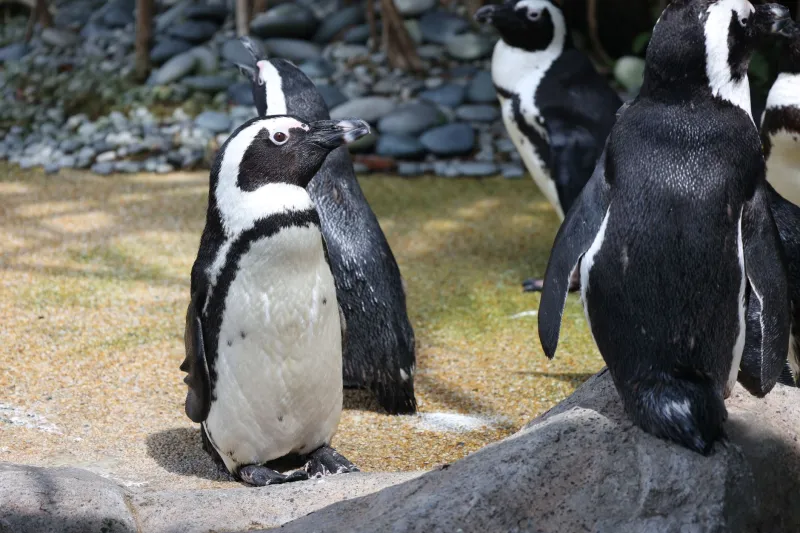
Let's get one thing straight before we go any further: penguins have knees. Full, functional, genuinely real knees. You just can't see them because they're tucked up inside that tuxedo-shaped body like a secret the penguin has been keeping since the Eocene epoch. The next time you watch a penguin waddle across your TV screen during a nature documentary and think wow, that looks uncomfortable, just know that it isn't waddling because it lacks joints. It's waddling because its entire leg situation is essentially a pair of very short thighs doing all the heavy lifting while the knees stay hidden indoors.
This is not an isolated incident. Evolution, it turns out, is less of a clean-slate renovator and more of a contractor who just keeps building on top of old foundations without ever hauling away the debris. The result is a natural world absolutely packed with body parts that don't obviously belong, bones that seem to have no current job description, and anatomical leftovers that quietly tell the story of where every living thing actually came from.
The Whale With the Ghost Hips
Whales are, by most observable metrics, fish-shaped. They live in the ocean. They do not walk anywhere. They have not walked anywhere for roughly 50 million years. And yet, floating around inside a whale's body — not connected to anything, not doing any visible work — are small bones that are, without question, remnants of a pelvis.
Scientists call these vestigial structures, which is the polite scientific way of saying "evolutionary leftovers that the body forgot to throw out." For a long time, the whale pelvis was held up as the classic example of a structure that had simply lost its purpose. A biological appendix, more or less. But more recent research has suggested these bones may actually still be doing something — specifically, helping anchor muscles involved in reproduction. Evolution kept the hips around not because it's sentimental, but because even a stripped-down version of an old structure can still pull its weight in a new context.
The real headline here, though, is what those bones mean. Whales evolved from land mammals. There were, in fact, creatures walking around on four legs tens of millions of years ago that were the distant ancestors of every whale and dolphin alive today. The bones inside modern whales are a direct, physical record of that transition — like finding the original blueprints for a building that got completely demolished and rebuilt as something else entirely.
Snakes: More Legs Than Advertised
If whales having phantom hips seems surprising, consider the snake. Certain species — boas and pythons, specifically — still carry tiny, claw-like remnants of what were once hind legs. These are called pelvic spurs, and in some species they're actually visible as small, fingernail-sized protrusions near the tail. Males of certain species even use them during mating.
The snake's legless body plan is so complete, so thoroughly committed, that it's easy to forget the whole thing started with a lizard. But the spurs don't let you forget. They're right there, small and stubborn, quietly insisting that snakes did not always slither. At some point, something that looked a lot more like a lizard made a very consequential lifestyle pivot, and the legs gradually disappeared — except for these two tiny holdouts that apparently didn't get the memo.
Your Own Body Is Also Full of Evolutionary Receipts
Before you feel too superior about all of this, it's worth noting that the human body is equally cluttered with anatomical artifacts. The appendix is the famous one — long assumed to be completely useless, now understood to play a role in gut immunity, though you can clearly survive without it since people do that all the time. The goosebump reflex exists because our ancestors had enough body hair that raising it actually served a purpose, either to trap heat or to make them look bigger to predators. Neither of those functions is particularly relevant to the average American standing in a slightly chilly grocery store aisle.
Then there's the palmaris longus — a tendon in your forearm that roughly 14 percent of people are born without, and whose absence causes zero functional problems whatsoever. You can test for it right now: press your pinky and thumb together and flex your wrist. If you see a raised tendon running up the center of your forearm, you have one. If you don't, congratulations, you're slightly further along in a process that has been quietly phasing it out for generations.
The plantaris muscle in your leg is on the same trajectory — present in most people, absent in some, and apparently so unimportant that surgeons frequently harvest it for use in reconstructive procedures elsewhere in the body without any negative effect on the donor site.
Evolution Is a Pack Rat, and That's Actually Great
The reason all of this is so fascinating — and not just academically, but genuinely, stare-at-the-ceiling-at-2am fascinating — is what it reveals about how life actually works. Evolution doesn't design from scratch. It tinkers. It modifies. It repurposes. The same basic bone structure that makes up your hand also makes up a bat's wing, a dolphin's flipper, and a horse's leg. The architecture is shared. The applications are just wildly different.
This means that when you look at a penguin waddling around like it's late for a very important meeting, you're not just looking at a penguin. You're looking at a compressed record of hundreds of millions of years of trial and error, adaptation and abandonment, structures kept and structures lost. The hidden knees aren't a quirk. They're a chapter in a very long story.
And somewhere in the deep ocean right now, a whale is swimming through the dark with its tiny ghost hips, completely unbothered, not thinking about any of this.
Which, honestly, is the correct response.