The Creature With Nine Brains Is Out Here Making You Look Indecisive at the Grocery Store
Picture yourself at the grocery store. You're in the produce section. You pick up an avocado, squeeze it, put it back, pick up another one, doubt yourself, google "how to tell if an avocado is ripe," read three conflicting articles, and ultimately leave with a mango you didn't plan on buying. One brain. Total chaos.
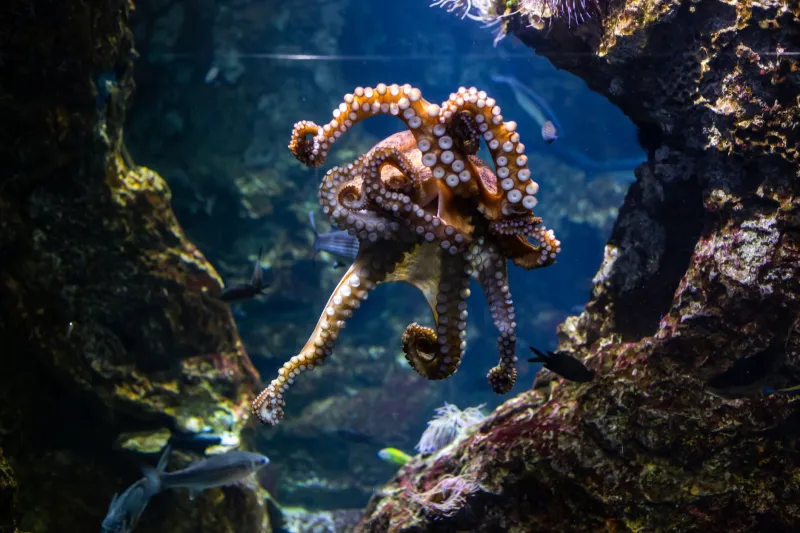
Now picture an octopus hunting for crabs along the ocean floor. Eight arms moving simultaneously through rock crevices, each one probing, grabbing, tasting, and deciding — all at the same time, without waiting for a committee meeting upstairs. Nine brains. Zero hesitation. Dinner secured.
Welcome to one of the most genuinely strange facts in all of animal biology, and also a mild personal insult delivered by nature itself.
So Wait — Nine Brains? How Does That Even Work?
Here's the deal. An octopus has one central brain, located between its eyes, that handles the big-picture stuff — perception, memory, the general vibe of being an octopus. But each of its eight arms contains its own cluster of neurons, called a ganglion, that functions as an independent mini-brain. And we're not talking about a few scattered nerve cells doing some light processing. Each arm's neural cluster contains more than half of the octopus's total neurons.
Let that sink in. The arms aren't waiting for instructions from headquarters. They're out there freelancing.
When researchers have severed an octopus arm from its body — which sounds horrifying but is done in the name of science — the arm continues to respond to stimuli, reach toward food, and perform coordinated movements for up to an hour. The arm doesn't know the meeting has been cancelled. It just keeps working the problem.
This is called distributed intelligence, and it is, depending on your perspective, either the most efficient system ever designed by evolution or the most unsettling thing you'll read this week.
Your Brain's Whole Thing Is Being the Boss. The Octopus Skipped That Part.
Human brains are centralized. Everything routes through the top. You see a ripe avocado, your eyes send a signal up to your visual cortex, your prefrontal cortex weighs in on the decision, your memory chips in with the time you bought a bad one in 2019, your anxiety offers an uninvited opinion, and eventually — eventually — your hand moves. By which point someone else has taken the good avocado.
The octopus has essentially solved this bottleneck by giving each arm its own local government. The central brain sets a general goal — "find food over there" — and then the arms figure out the specifics themselves. They navigate around obstacles, adjust grip strength, and respond to texture and taste without ever filing a report upstairs. It's delegation taken to its biological extreme.
Neuroscientists find this fascinating because it challenges the assumption that intelligence requires a command-and-control structure. The octopus isn't dumber for having a distributed system. In many ways, it's faster, more adaptable, and frankly better at multitasking than most mammals — including the ones writing articles about avocados.
What This Says About Intelligence (And Why It Should Humble Us)
For a long time, humans ranked intelligence by how much something resembled our own cognitive setup: big centralized brain, complex social behavior, tool use, the whole package. Octopuses kept quietly breaking that rubric.
They use tools. They solve puzzles. They recognize individual human faces — and yes, they can hold a grudge against a specific person who annoyed them, which is a level of pettiness most of us respect. They've been observed unscrewing jar lids, navigating mazes, and playing with objects in ways that suggest something very close to curiosity.
And they do all of this with a nervous system that looks nothing like ours, built on a completely different evolutionary blueprint. Vertebrates and cephalopods — the group that includes octopuses — diverged somewhere around 500 to 700 million years ago. Whatever intelligence the octopus has, it invented independently. It didn't inherit our approach. It came up with its own.
That's the part that keeps neuroscientists up at night in a good way. Intelligence isn't one thing. It's a solution to a problem, and evolution has apparently solved it multiple times, through multiple routes, using wildly different hardware.
The Produce Section Problem, Revisited
So what does any of this mean for you and your grocery paralysis?
Psychologists have a name for what happens when humans overthink low-stakes decisions: analysis paralysis. It's what kicks in when your centralized brain — brilliant, well-intentioned, catastrophically over-equipped for squeezing fruit — starts looping through every possible outcome of a choice that genuinely does not matter that much. The avocado will either be ripe or it won't. No amount of additional processing time changes the avocado.
The octopus doesn't have this problem, not because it's smarter in the way we usually mean the word, but because its architecture doesn't allow for it. The arm that finds food acts on the find. There is no second-guessing committee. There is no "but what if the crab is a little too crabby today." There is only the arm, the crab, and dinner.
Now, humans have genuinely good reasons for centralized decision-making. We plan for the future, consider consequences, weigh moral implications, and occasionally make choices that affect other people. An octopus is not doing any of that. It lives for about three to five years, it doesn't form long-term social bonds, and it is not worried about what its arms think of each other. The system works for the octopus's life, not necessarily for ours.
But there's still something worth borrowing from the nine-brained weirdo of the ocean floor: sometimes the smartest move is trusting the part of you that's already closest to the problem.
The Takeaway (Delivered by an Animal That Has Eight of Them)
The octopus is, by almost any measure, one of the most alien intelligences on Earth. It's soft-bodied, short-lived, and almost entirely boneless, and it is out here running nine simultaneous decision-making processes while you're still reading the back of a granola bar.
The fact that it pulls this off through a completely different neurological design than ours is a useful reminder that the brain you have isn't the only way to be smart. It's just the one evolution handed you.
Use it wisely. Maybe start with the avocados.