Your Brain Memorized Every Word of a 30-Year-Old Taco Bell Ad But Forgot Your Own ZIP Code
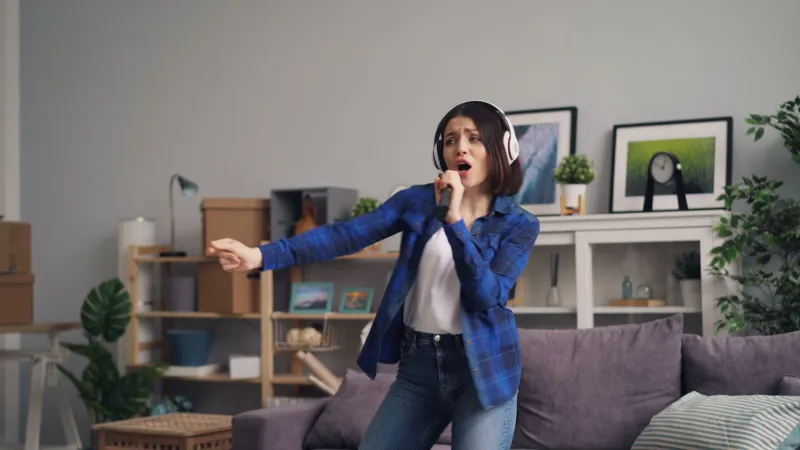
Let's set the scene. You're standing at the post office, pen in hand, and your mind goes completely blank on your own ZIP code — the one you've used approximately four thousand times. You stare at the form. Nothing. Pure static.
And then, unprompted, your brain cheerfully serves up: "Two all-beef patties, special sauce, lettuce, cheese, pickles, onions on a sesame seed bun."
Congratulations. You have successfully recited a McDonald's jingle from 1974 while failing to remember where you live.
You are not alone. You are not losing your mind. You are, in fact, doing exactly what human brains were apparently designed to do — and the science behind it is equal parts fascinating and deeply humbling.
Your Brain Has a VIP Section, and Jingles Got the Wristband
Here's the thing about memory: your brain doesn't store everything equally, like some kind of unbiased filing cabinet. It's more like a bouncer at an exclusive club. Certain information gets ushered right to the front. Other stuff — your dentist's phone number, your coworker's last name, where you put your keys — gets stuck outside in the rain.
So what's the secret password that gets a jingle past the velvet rope?
Neuroscientists point to something called melodic encoding — the brain's tendency to latch onto information that's wrapped in a musical package. When you hear a catchy tune, multiple regions of your brain light up simultaneously: the auditory cortex processes the sound, the motor cortex starts quietly tapping along, and the limbic system — the emotional headquarters of your brain — decides whether this deserves to be filed under "keep forever."
Spoiler: it almost always decides yes.
Music, it turns out, is basically a memory cheat code. The rhythm creates a predictable pattern that your brain finds deeply satisfying to complete. The repetition hammers the neural pathway deeper every single time you hear it. And the melody acts like a retrieval hook — once you hear even three notes, your brain can't help but finish the whole thing.
This is why you can reconstruct the entire Meow Mix commercial from a single meow but cannot recall what you had for lunch on Tuesday.
The Earworm Is Not a Bug. It's a Feature.
Scientists have a clinical term for the songs that get stuck in your head: involuntary musical imagery, or INMI. (Researchers clearly had no interest in making that acronym fun.) The rest of us call them earworms, which is honestly a much more accurate description of the experience.
Earworms aren't random. Research from the University of London found that earworm-prone songs tend to share specific characteristics: a fast tempo, a very simple and repetitive melodic pattern, and a small unexpected twist that your brain finds slightly unresolved — like an itch it keeps trying to scratch.
Marketing teams figured this out decades before the neuroscientists published their papers. The five-note McDonald's hook? Mathematically engineered to be unfinished enough that your brain wants to complete it. The Nationwide Insurance jingle? Structured so that the rhythm alone triggers the words before you've consciously decided to sing along. These weren't happy accidents. They were calculated earworm deployments.
You were essentially ambushed by a tune, and your brain signed the lease without asking you.
Evolution Didn't Plan for the 30-Second Spot, But Here We Are
Here's where it gets genuinely interesting. Your brain's obsession with musical patterns almost certainly predates television commercials by, oh, about a hundred thousand years.
Anthropologists believe that early humans used rhythmic chanting and song to pass down critical survival information — which plants would kill you, which seasons brought floods, where to find water. Before written language, melody was basically the cloud storage of the ancient world. If you could remember the song, you could remember the knowledge.
Your brain is still running that same ancient software. It hears a structured, repetitive melodic pattern and thinks, "This must be important survival information. Better lock it in permanently."
It has absolutely no way of knowing that the "survival information" in question is the phone number for a local carpet cleaning company set to a jaunty tune. It just knows: melody equals important. Store forever.
Meanwhile, your actual phone number — delivered to your brain as a flat, unmelodic string of digits with zero emotional resonance — gets treated like a sticky note that falls behind the refrigerator.
Why Emotional Glue Makes Everything Stick
Music doesn't just exploit your brain's pattern-recognition systems. It also hijacks your emotional memory, which is genuinely the strongest kind of memory you have.
Think about it: you probably remember exactly where you were the first time you heard a song that hit you hard. You remember the specific McDonald's from your childhood road trips, the smell of the vinyl seats, the specific joy of a Happy Meal toy. The jingle didn't just get filed as audio data — it got stapled to an entire emotional experience.
This is why nostalgia marketing is worth billions of dollars. Brands that get their jingle into your childhood create a memory structure so deeply embedded that it survives decades of brain reorganization. You're not just remembering a tune. You're remembering being seven years old and genuinely happy about a small plastic toy.
Your ZIP code, unfortunately, has never once made you feel anything.
The Upside of Your Ridiculous Jingle Brain
Before you feel too bad about your brain's bizarre priorities, here's a reframe: the same mechanism that locked in "I'm lovin' it" can be deliberately hijacked for good.
Students who set their multiplication tables to music learn them faster and retain them longer. Medical students use rhythmic mnemonics to memorize drug interactions. Language learners who use song-based methods outperform those who use traditional memorization by a significant margin.
Your brain isn't malfunctioning. It's actually revealing its own instruction manual. It's telling you, quite clearly, that it responds to rhythm, repetition, melody, and emotional context. It learns best when information feels like something — not just a string of neutral data.
The brain that can't remember a phone number but nails a 1990s Pizza Hut jingle isn't a broken brain. It's an ancient, pattern-hungry, emotionally-driven supercomputer that happens to be running in a world full of very clever advertisers who read the manual first.
The Fact You'll Definitely Remember Now
The average American adult can accurately recall the lyrics or melody of hundreds of commercial jingles — many from brands that no longer exist — but studies consistently show that most people cannot recite more than two or three phone numbers from memory.
Your brain traded contact information for a comprehensive internal jukebox of corporate audio branding.
Honestly? Respect the commitment.